Curtis Botanical Magazine
Curtis Botanical - Plate 255 - Cytisus sessilifolius / Sessile-leaved Cytisus, or Common Cytisus
Curtis Botanical - Plate 255 - Cytisus sessilifolius / Sessile-leaved Cytisus, or Common Cytisus
Couldn't load pickup availability
Original hand-colored antique botanical print from Curtis's Botanical Magazine - Plate 255, Cytisus sessilifolius (Sessile-leaved Cytisus, or Common Cytisus).
- Plate: 255
- Latin name: Cytisus sessilifolius
- Common name: Sessile-leaved Cytisus, or Common Cytisus
- Native region: Southern Europe
- Flowering: May and June
- Flower colour: Yellow
- Linnaean class / order: Diadelphia / Decandria
- Publication: Feb 1 1799
- Engraver: F. Sansom
- Medium: Original hand-colored engraving (physical print, not a reproduction)
Original Curtis text
Transcribed from the plate's accompanying description page:
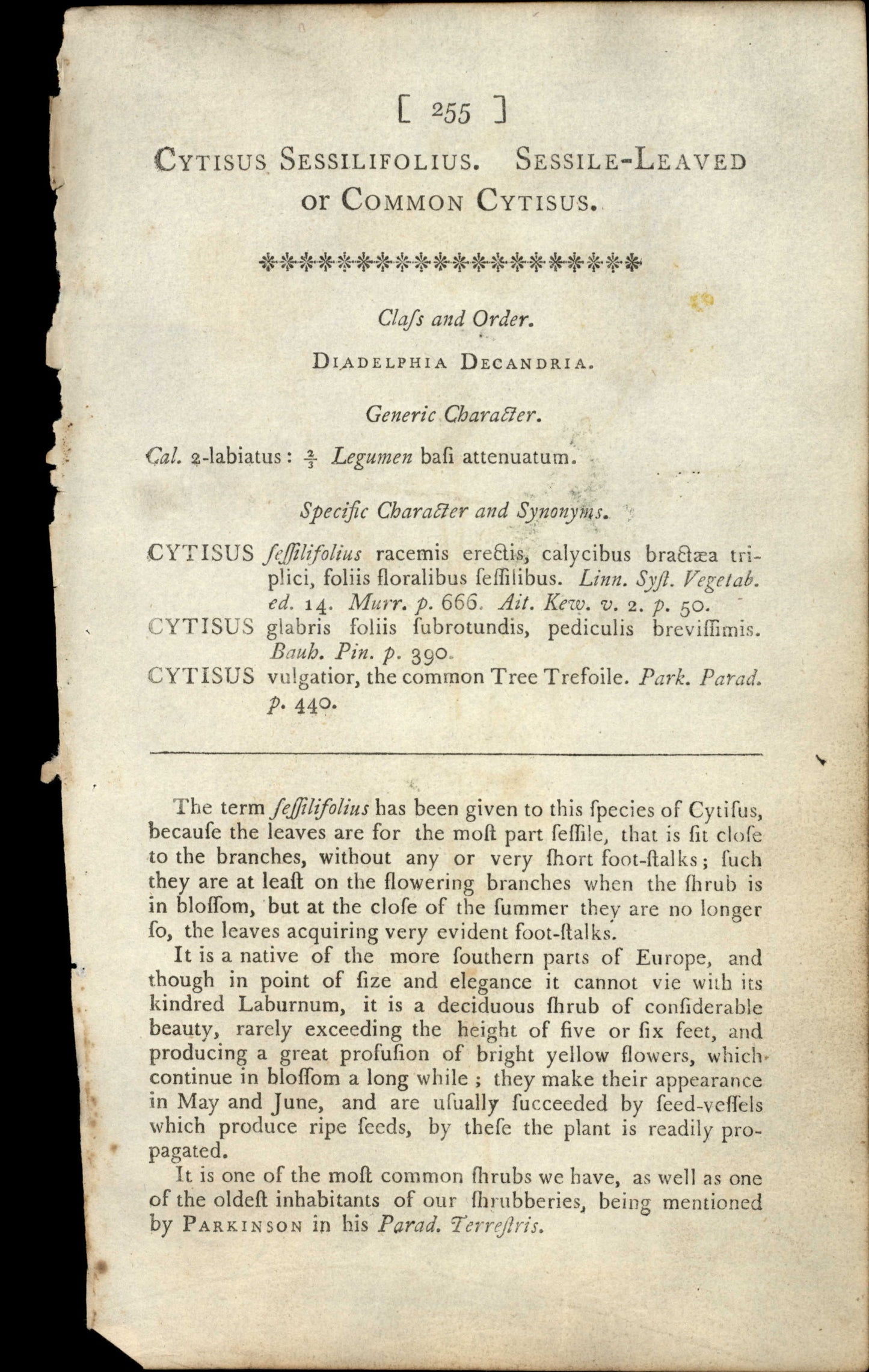
[ 255 ]
CYTISUS SESSILIFOLIUS. SESSILE-LEAV'D, OR COMMON CYTISUS.
. . .
Class and Order.
DIADELPHIA DECANDRIA.
Generic Character.
Cal. 2-labiatus: ⚘ Legumen basi attenuatum.
Specific Character and Synonyms.
CYTISUS sessilifolius racemis erectis, calycibus bracteâ triplici, foliis floralibus sessililibus. Linn. Syst. Vegetab. ed. 14. Murr. p. 666. Ait. Kew. v. 2, p. 50. CYTISUS glabris foliis subrotundis, pediculis brevissimis. Bauh. Pin. p. 390. CYTISUS vulgalior, the common Tree Trefoile. Park. Parad. p. 440. The term sessilifolius has been given to this species of Cytisus, because the leaves are for the most part sessile, that is fit close to the branches, without any or very short foot-stalks; such they are at least on the flowering branches when the shrub is in bloffom, but at the close of the summer they are no longer so, the leaves acquiring very evident footstalks.
It is a native of the more southern parts of Europe, and though in point of size and elegance it cannot vie with its kindred Laburnum, it is a deciduous shrub of considerable beauty, rarely exceeding the height of five or six feet, and producing a great profusion of bright yellow flowers, which continue in blofflom a long while; they make their appearance in May and June, and are usually succeeded by seed-vessels which produce ripe seeds, by these the plant is readily propagated. It is one of the most common shrubs we have, as well as one of the oldest inhabitants of our shrubberies, being mentioned by PARKINSON in his Parad. Terrestris.
This is an original plate from leftover publisher stock of Curtis's Botanical Magazine. It was never bound into a volume. This holding reached us through the British natural-history dealer Wheldon & Wesley. Sold as an original historic plate — please review photos for condition.
Share