Curtis Botanical Magazine
Curtis Botanical Magazine Plate 1024 - Fuchsia lycioides (Box-Thorn Fuchsia) | Original Hand-Colored Print
Curtis Botanical Magazine Plate 1024 - Fuchsia lycioides (Box-Thorn Fuchsia) | Original Hand-Colored Print
Couldn't load pickup availability
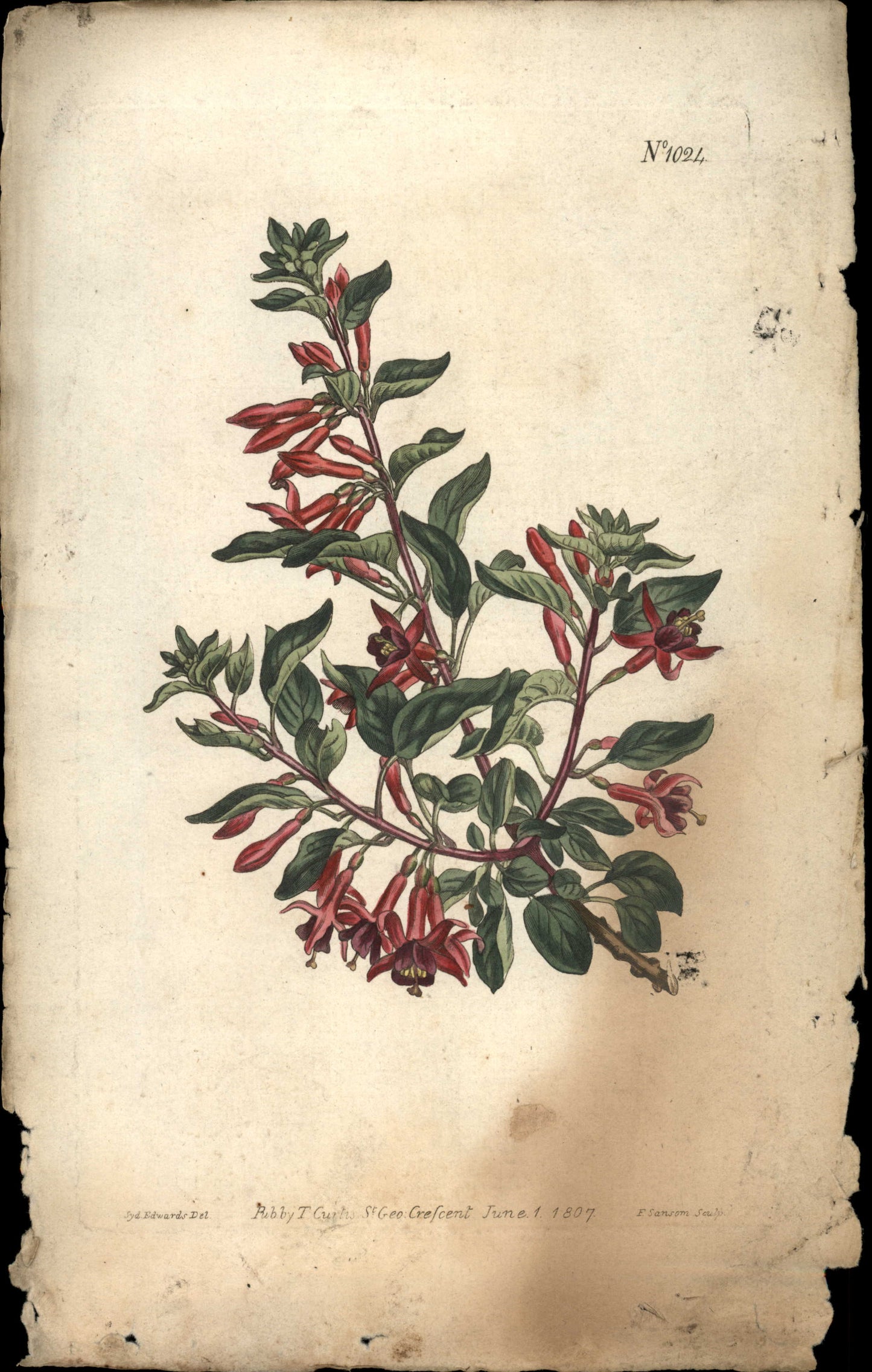
Original hand-colored antique botanical print from Curtis's Botanical Magazine - Plate 1024, Fuchsia lycioides (Box-Thorn Fuchsia).
- Plate: 1024
- Latin name: Fuchsia lycioides
- Common name: Box-Thorn Fuchsia
- Native region: Chili
- Flowering: August to November
- Linnaean class / order: Octandria / Monogynia
- Publication: June 1, 1807
- Artist: Abbey Turk
- Engraver: F. Sansom
- Medium: Original hand-colored engraving (physical print, not a reproduction)
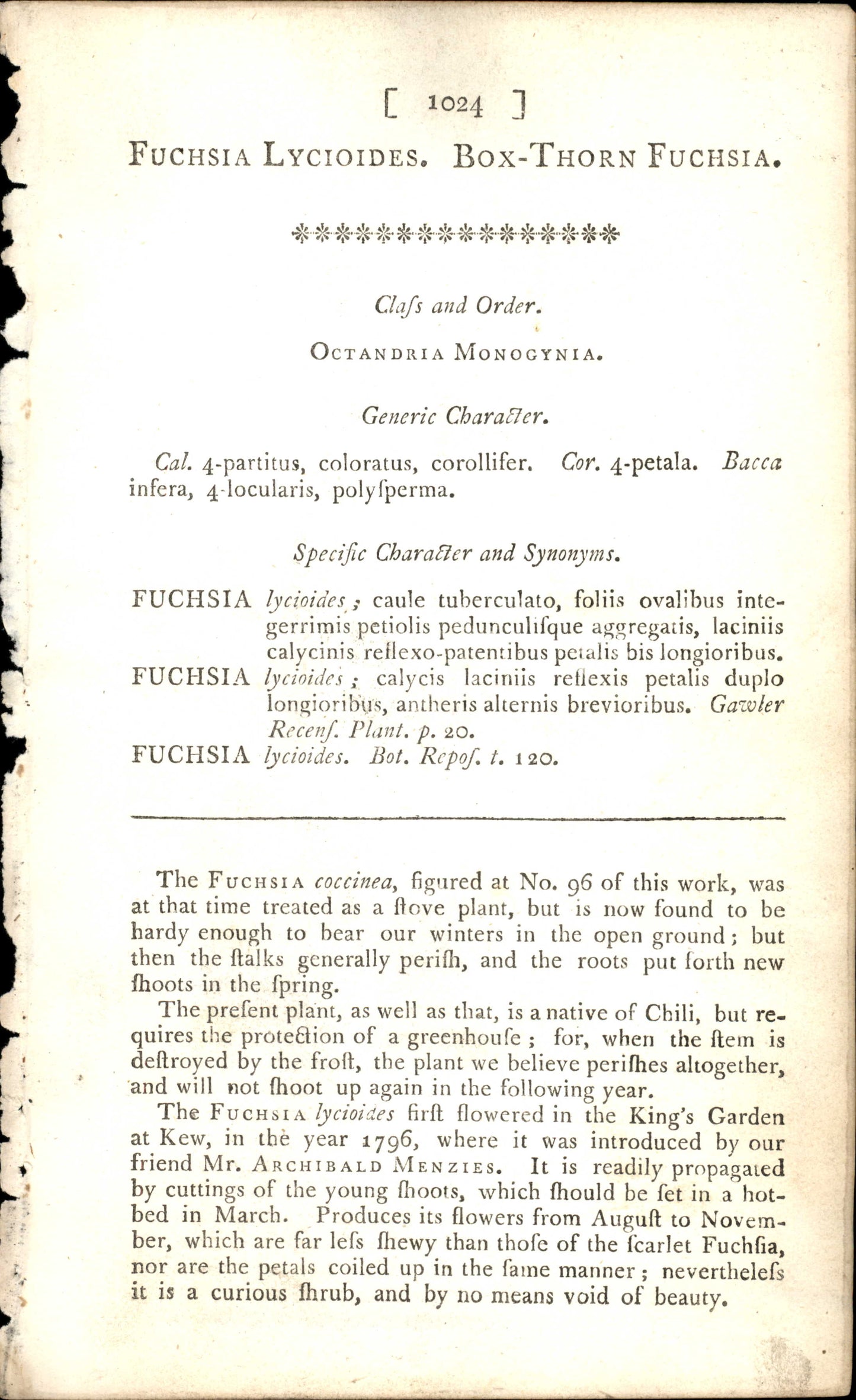
Original Curtis text
Transcribed from the plate's accompanying description page:
[ 1024 ]
FUCHSIA LYCIOIDES. BOX-THORN FUCHSIA.
. . .
Class and Order.
OCTANDRIA MONOGYNIA.
Generic Character.
Cal. 4-partitus, coloratus, corollifer. Cor. 4-petala. Bacca infera, 4-locularis, polysperma.
Specific Character and Synonyms.
FUCHSIA lycioides; caule tuberculato, foliis ovalibus integerrimis petiolis pedunculique aggregatis, laciniis calycinis reflexo-patentibus petalis bis longioribus. FUCHSIA lycioides; calycis laciniis reflexis petalis duplo longioribus, antheris alternis brevioribus. Gawler Recent. Plant. p. 20. FUCHSIA lycioides. Bot. Repos. t. 120.
The FUCHSIA coccinea, figured at No. 96 of this work, was at that time treated as a stove plant, but is now found to be hardy enough to bear our winters in the open ground; but then the stalks generally perish, and the roots put forth new shoots in the spring. The present plant, as well as that, is a native of Chili, but requires the protection of a greenhouse; for, when the stem is destroyed by the frost, the plant we believe perishes altogether, and will not shoot up again in the following year. The FUCHSIA lycioides first flowered in the King's Garden at Kew, in the year 1796, where it was introduced by our friend Mr. ARCHIBALD MENZIES. It is readily propagated by cuttings of the young shoots, which should be set in a hot-bed in March. Produces its flowers from August to November, which are far less showy than those of the scarlet Fuchsia, nor are the petals coiled up in the same manner; nevertheless it is a curious shrub, and by no means void of beauty.
This is an original plate from leftover publisher stock of Curtis's Botanical Magazine. It was never bound into a volume. This holding reached us through the British natural-history dealer Wheldon & Wesley. Sold as an original historic plate — please review photos for condition.
Share