Curtis Botanical Magazine
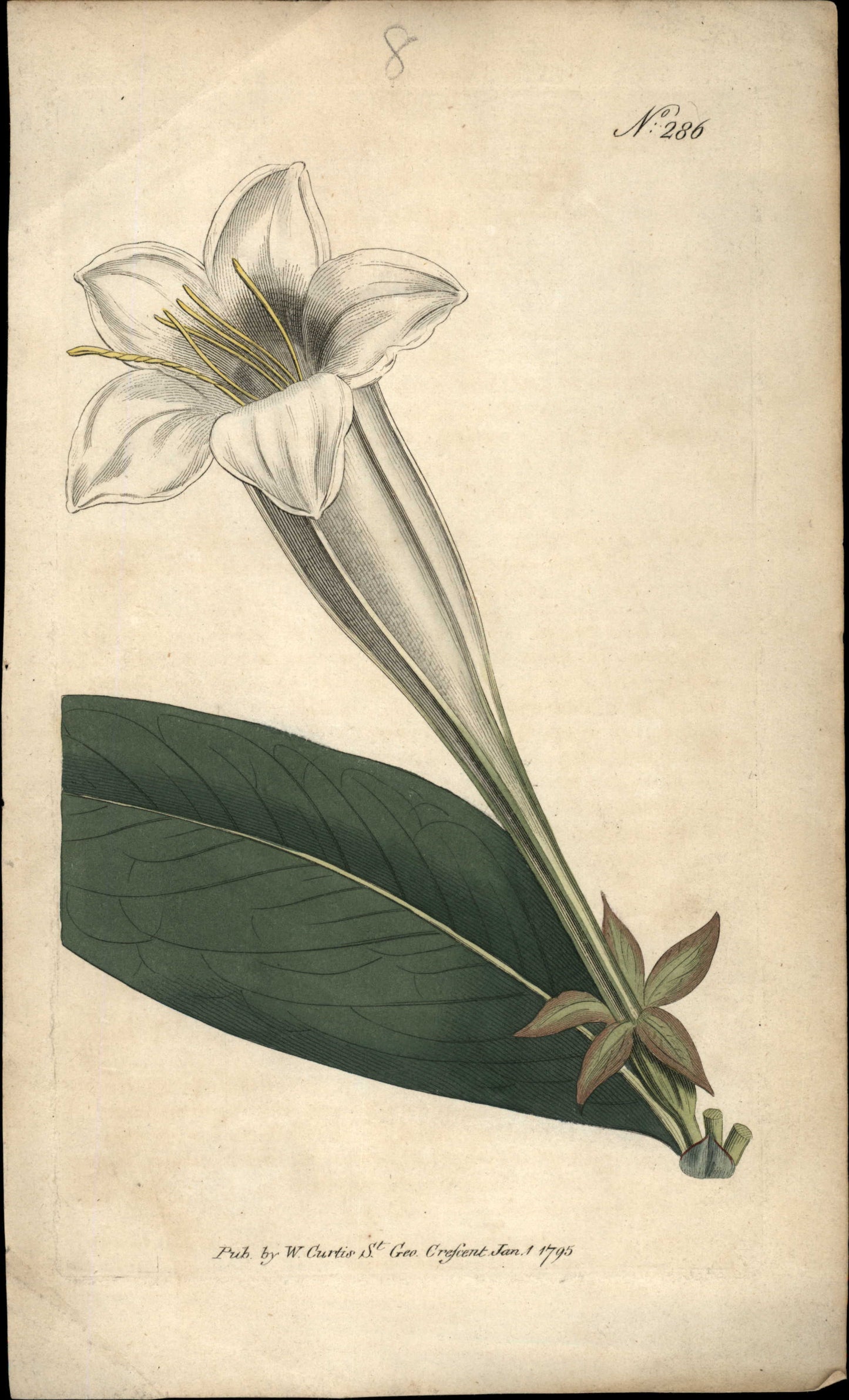
Curtis Botanical Magazine Plate 286 - Portlandia grandiflora (Great-flowered Portlandia) | Original Hand-Colored Print
Curtis Botanical Magazine Plate 286 - Portlandia grandiflora (Great-flowered Portlandia) | Original Hand-Colored Print
Couldn't load pickup availability
Original hand-colored antique botanical print from Curtis's Botanical Magazine - Plate 286, Portlandia grandiflora (Great-flowered Portlandia).
- Plate: 286
- Latin name: Portlandia grandiflora
- Common name: Great-flowered Portlandia
- Native region: Jamaica
- Flowering: Summer to Autumn
- Linnaean class / order: Pentandria / Monogynia
- Publication: Jan 1 1795
- Medium: Original hand-colored engraving (physical print, not a reproduction)
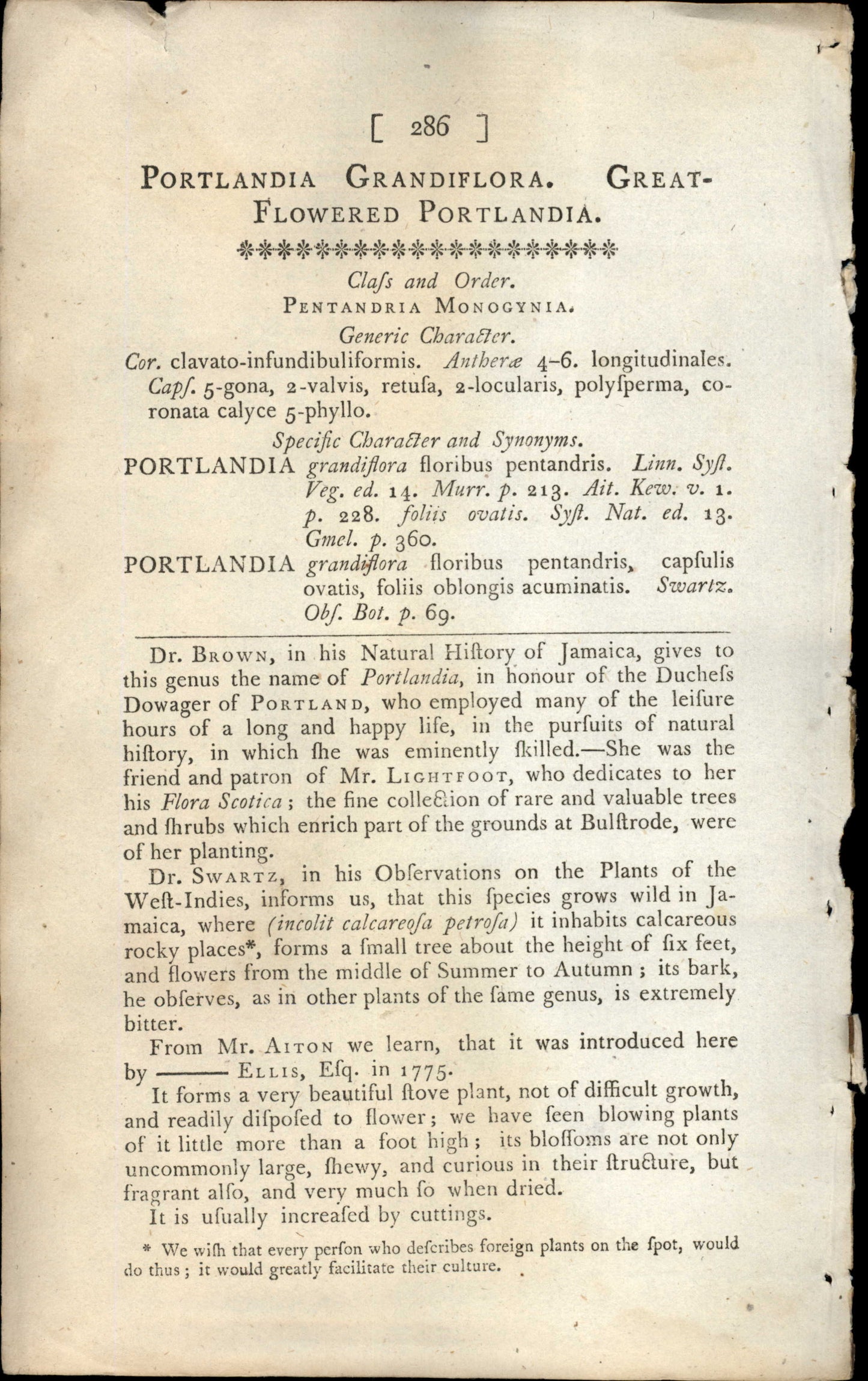
Original Curtis text
Transcribed from the plate's accompanying description page:
[ 286 ]
PORTLANDIA GRANDIFLORA. GREAT-FLOWERED PORTLANDIA.
. . .
Class and Order.
PENTANDRIA MONOGYNIA.
Generic Character.
Cor. clavato-infundibuliformis. Anthere 4-6. longitudinales. Capl. 5-gona, 2-valvis, retula, 2-locularis, polysperma, coronata calyce 5-phyllo.
Specific Character and Synonyms.
PORTLANDIA grandiflora floribus pentandris. Linn. Syst. Veg. ed. 14. Murr. p. 213. Ait. Kew. v. 1. p. 228. follis ovalis. Syst. Nat. ed. 13. Gmel. p. 360. PORTLANDIA grandiflora floribus pentandris, capsulis ovatis, foliis oblongis acuminatis. Swartz. Obs. Bot. p. 69. Dr. BROWN, in his Natural History of Jamaica, gives to this genus the name of Portlandia, in honour of the Duchess Dowager of PORTLAND, who employed many of the leisure hours of a long and happy life, in the pursuits of natural history, in which she was eminently skilled.—She was the friend and patron of Mr. LIGHTFOOT, who dedicates to her his Flora Scotica; the fine collection of rare and valuable trees and shrubs which enrich part of the grounds at Bulstrode, were of her planting. Dr. SWARTZ, in his Observations on the Plants of the West-Indies, informs us, that this species grows wild in Jamaica, where (incolt calcareofa petrofa) it inhabits calcareous rocky places*, forms a small tree about the height of fix feet, and flowers from the middle of Summer to Autumn; its bark, he observes, as in other plants of the fame genus, is extremely bitter. From Mr. AITON we learn, that it was introduced here by ———— ELLIS, Esq. in 1775.
It forms a very beautiful stove plant, not of difficult growth, and readily disposed to flower; we have feen blowing plants of it little more than a foot high; its bloffoms are not only uncommonly large, shewy, and curious in their structure, but fragrant also, and very much so when dried. It is usually increafed by cuttings. * We wifh that every perfon who defcribes foreign plants on the fpot, would do thus; it would greatly facilitate their culture.
This is an original plate from leftover publisher stock of Curtis's Botanical Magazine. It was never bound into a volume. This holding reached us through the British natural-history dealer Wheldon & Wesley. Sold as an original historic plate — please review photos for condition.
Share